How to Choose the Best Lawnmower Batteries for Your Mower
Choosing the best lawnmower batteries is not simply a matter of buying the highest capacity. The right battery must match your mower’s voltage, connector, tray size, charging system, and working demands. A 40-volt battery cannot safely replace a 24-volt model. Check the owner’s manual before trusting an online product description.
Battery-industry expert Isidor Buchmann offers a useful reminder: “A battery is like a human being; it needs exercise.” His point matters in seasonal equipment. A battery left untouched in a cold shed may lose performance before spring mowing begins. Regular charging, correct storage, and a compatible charger can protect its useful life. Do not confuse amp-hours with power. Amp-hours usually indicate runtime, while voltage reflects the system’s electrical requirement. Higher capacity may provide longer cutting time, but it can also add weight and cost. That trade-off feels small until you carry the mower across a wet yard.
Lithium-ion lawnmower batteries usually deliver lighter handling and steady output. Lead-acid batteries may cost less, but they can be heavier and need more careful maintenance. Still, neither chemistry is automatically best. Your lawn size, grass thickness, slope, climate, and charging habits matter more than marketing language. A battery claiming “long life” may perform poorly if stored overheated or charged incorrectly. The word “best” is imperfect here. The practical choice is the safest compatible battery that fits your routine, budget, and mower. Even experienced users should recheck the manual before replacing an original pack.
Identify Your Mower’s Battery Type and Power Requirements
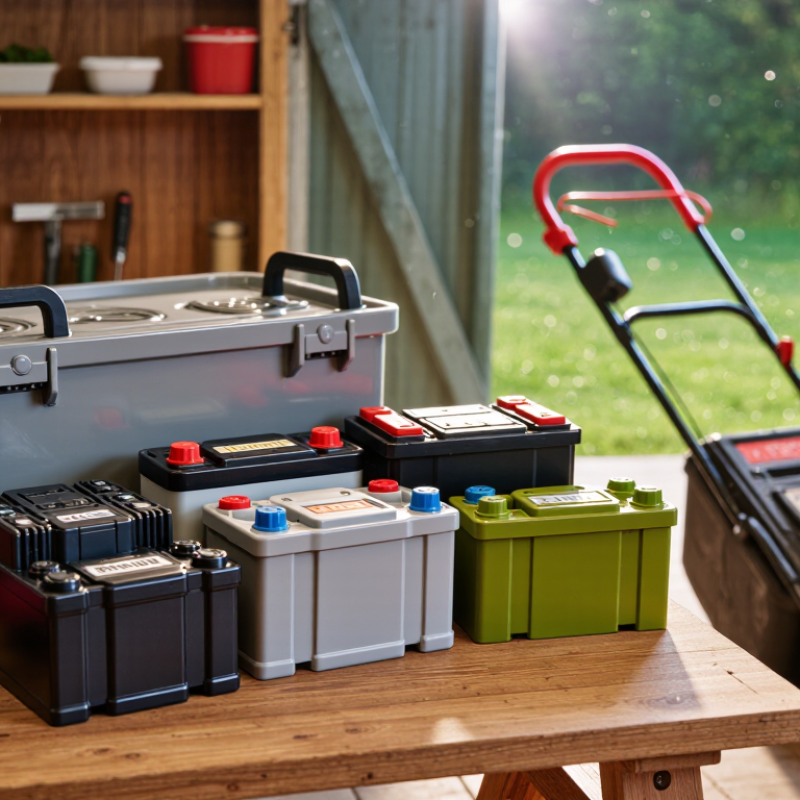
Choosing a lawnmower battery starts with identification, not price. Check the original battery label, mower manual, and charger output. Common ride-on mowers use 12-volt lead-acid batteries. Cordless walk-behind models often use lithium-ion packs between 18 and 80 volts.
Voltage must match exactly. A higher-voltage battery can damage the controller, motor, or charger.
Then calculate the mower’s power requirement. Battery energy is approximately voltage multiplied by amp-hours.
A 40-volt, 5-Ah pack stores about 200 watt-hours under laboratory conditions.
Real cutting time is lower because grass height, blade resistance, slope, and heat increase consumption. Allow roughly 70 percent usable energy for a practical estimate. The International Energy Agency reported average lithium-ion battery pack prices near 139 dollars per kilowatt-hour in 2023. That figure reflects broader battery markets, not mower performance, but it shows why capacity and cycle life deserve attention.
Look for chemistry, terminal layout, physical dimensions, and battery-management requirements. A lithium pack cannot replace a lead-acid battery without compatible electronics and charging controls. Measure the compartment before ordering. Keep the old battery nearby. I once focused on amp-hours and ignored terminal placement; the battery fit loosely and caused intermittent starting. That mistake was avoidable. Safety guidance from UL Solutions also emphasizes approved charging systems, protected cells, and damage inspection.
Do not use a swollen pack. Stop immediately.
A mower that loses power on thick, wet grass may need more energy capacity, a sharper blade, or reduced cutting height—not simply a larger battery.
Compare Battery Voltage, Capacity, and Runtime
How to Choose the Best Lawnmower Batteries for Your Mower
Choosing a lawnmower battery starts with voltage, not advertised runtime. Voltage must match the mower’s electrical system. A higher number is not automatically a safe upgrade. Check the mower label and manual before buying. The wrong voltage can reduce performance or damage the controller. In routine mower maintenance, I also inspect the connector and battery compartment. They must fit firmly. Loose contacts can imitate a weak battery.
Capacity is measured in amp-hours, or Ah. Higher Ah usually means more stored energy and longer cutting time. It also adds weight and may increase charging time. Weight matters too. Runtime depends on grass height, moisture, blade sharpness, slopes, and cutting width. Dry, short grass uses less power than thick, wet growth. A rough estimate uses watt-hours divided by average power. Watt-hours equal voltage multiplied by amp-hours. Real results vary. My first estimate was too optimistic because it ignored heavy spring grass.
Compare batteries using both capacity and usable runtime. A 40-volt, 5-Ah battery stores about 200 watt-hours before operating losses. Avoid draining it completely during every session. Leaving some reserve helps prevent sudden power loss near the end of a row. Cold batteries often deliver less energy. Measure one full mowing session and record the remaining charge. That simple log is more reliable than a showroom claim. If you mow slopes or dense grass often, confirm that the added battery weight still feels manageable.
Evaluate Battery Chemistry, Charging Time, and Lifespan
Choosing the best lawnmower battery starts with chemistry, not price. Lithium-ion batteries usually provide higher energy density and lower weight than lead-acid designs. The U.S. Department of Energy reports that lithium-ion systems commonly achieve about 150–265 Wh/kg, depending on chemistry and pack design. That difference matters when lifting a mower onto a shelf.
PRACTICAL TESTING
Charging time also needs practical testing. A battery advertised as “fast charging” may still need two hours after heavy mowing. Check charger output, battery capacity, and operating temperature together. Argonne National Laboratory research identifies heat and high charge levels as major factors in lithium-ion aging. Store the battery cool, but never frozen. In my experience, leaving it fully charged in a hot shed causes more worry than useful convenience.
Lifespan figures require caution. DOE technical reviews show that lithium-ion cycle life can range from roughly 1,000 to 3,000 cycles, depending on chemistry, depth of discharge, and temperature. Real mowing conditions are less controlled. Wet grass, tall growth, and repeated deep discharges may shorten that number. Lead-acid batteries can cost less initially, but they are heavier and often tolerate fewer deep cycles. A 2024 industry analysis from BloombergNEF also reported continued battery-cost reductions, yet cheaper cells do not automatically mean longer service. Check the warranty, replacement availability, charging indicator, and documented cycle testing before buying. Forecasts can be imperfect. Your yard is not a laboratory.
Balance Safety, Warranty, and Overall Replacement Cost
Choosing the best lawnmower battery means comparing safety, warranty coverage, and replacement cost together. A low purchase price can hide charger incompatibility, short service life, or difficult installation. Check the mower’s voltage, terminal layout, battery dimensions, and charging requirements before ordering. One mismatch can stop the mower completely.
Safety deserves practical attention. Look for clear capacity ratings, protective casing, secure terminals, and documented quality testing. The U.S. Environmental Protection Agency reports that lead-acid batteries achieve recycling rates above 99% in the United States. This supports choosing a battery with a clear recycling route. For lithium-based batteries, avoid damaged casings, swelling, exposed wires, or unusual heat during charging. Never ignore these signs. I still find temperature limits easy to underestimate.
Warranty terms can change the real replacement cost. Read the coverage period, proof-of-purchase rules, return shipping duties, and exclusions for overcharging or improper storage. A longer warranty is useful only when the claim process is realistic. Industry warranty research often shows that exclusions matter as much as headline length, so record the purchase date and keep installation evidence. A simple cost comparison should include the battery, charger, delivery, disposal, and possible downtime.
Tips: Measure the old battery twice. Photograph its terminals. Ask whether the warranty includes capacity loss, not only total failure. Store the battery dry, cool, and partly charged when the manual permits. The cheapest option may be sensible, but only after these hidden costs are counted.
How to Choose the Best Lawnmower Batteries for Your Mower
Balance safety, warranty, and overall replacement cost with a battery that matches your mower’s voltage, charger, connector, and power requirements.
The chart uses representative midpoints for common residential mower battery categories. Lead-acid batteries generally have a lower purchase price but a shorter service life, while lithium-ion batteries usually cost more initially and can provide a lower estimated cost per service year. Always use the correct charger and battery-management system, check warranty coverage, and replace batteries that are swollen, cracked, leaking, overheating, or damaged.
Safety
Use a compatible battery and charger. Keep terminals clean and stop using any battery that shows physical damage or unusual heat.
Warranty
Typical coverage is about 1–3 years for lead-acid batteries and about 2–5 years for lithium-ion battery packs, depending on the seller and application.
Replacement Cost
The estimated annual cost divides the representative replacement price by expected service life; actual results depend on usage, storage, charging, and climate.