China has become a major sourcing center for reliable lawn-care power systems. Its supplier network includes factories serving commercial landscapers, equipment brands, and international distributors. For global buyers, selecting the right agm lawn mower battery requires more than comparing prices.
Dr. R. David Prengaman, a recognized lead-battery specialist, has said, “Lead batteries are the most recycled consumer product in the world.” This perspective matters when buyers assess AGM technology. Absorbent Glass Mat construction helps contain electrolyte and reduce leakage during vibration. It can also support dependable starting performance in demanding outdoor conditions. Still, results depend on plate design, separator quality, charging control, and factory testing.
Look closely at every detail. Ask for capacity data, cold-cranking performance, cycle-life results, and terminal specifications. Confirm whether testing covers heat, vibration, and repeated seasonal storage. A battery may look powerful on paper. Real performance can differ.
Reliable Chinese suppliers should provide traceable materials, consistent assembly, and clear warranty terms. They should also explain production capacity and export experience without making vague promises. International buyers need compatible dimensions, safe packaging, and documents suited to their destination market. ISO-related quality systems can support confidence, but certification alone proves little.
No supplier is perfect. That deserves attention.
The strongest purchasing decision balances technical evidence, field experience, communication, and total operating cost. This guide examines leading China-based AGM lawn mower battery suppliers and the practical criteria global buyers should use before placing an order. A careful comparison may prevent early capacity loss, difficult returns, and unnecessary downtime during the mowing season.
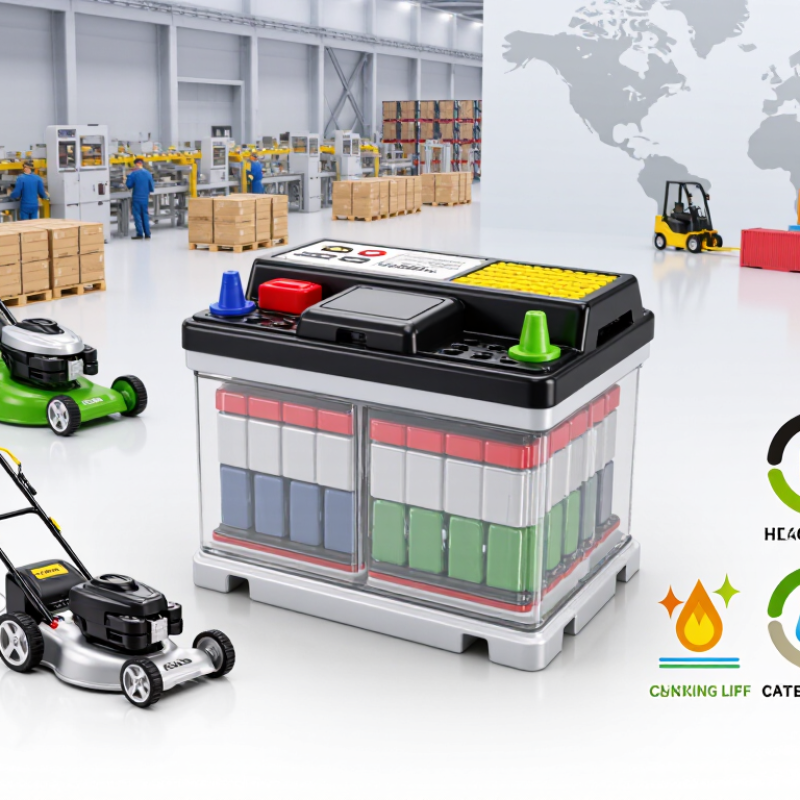
AGM lawn mower batteries use absorbent glass mat separators to hold electrolyte against the lead plates. This valve-regulated lead-acid design is sealed under normal operation. It reduces free-acid movement during vibration and transport. Inside the case, compressed glass fibers support plate spacing and improve contact stability. The result is a compact battery suited to riding mowers, robotic mowers, and electric-start equipment.
The design has practical strengths. AGM batteries deliver strong starting current, resist vibration, and require no routine water refilling. Their low internal resistance also supports repeated short starting cycles. Yet AGM is not magic. Deep discharge, heat, and incorrect charging can shorten service life quickly. A mower parked in direct summer sun may expose the battery to unnecessary stress. Buyers should check voltage, cold-cranking performance, terminal layout, dimensions, and charging compatibility before selecting a supplier.
The U.S. Environmental Protection Agency reports a lead-acid battery recycling rate of about 99 percent, supporting the technology’s established recovery system. IEC 60896-21 and IEC 60896-22 provide recognized test methods for valve-regulated stationary lead-acid batteries, although mower applications still require equipment-specific validation. Industry testing should include vibration, capacity retention, cycle performance, and low-temperature starting. Ask for traceable test records. Be cautious with impressive cycle-life claims lacking test conditions. That detail is often missed.
For global buyers, choosing an AGM lawn mower battery supplier requires more than comparing prices. Battery Council International’s 2023 market overview states that lead batteries provide more than 70% of rechargeable energy storage worldwide. This scale does not guarantee quality. Ask suppliers for verified capacity, cold-cranking performance, cycle-life results, and self-discharge data. These figures should match recognized testing methods, such as SAE J537 or relevant IEC procedures. Check the production date, too. An old AGM battery may lose performance before installation.
Reliability depends on manufacturing discipline. Request batch traceability, sealed-case inspection records, and test reports from independent laboratories. A supplier should explain how it controls electrolyte absorption, pressure regulation, vibration resistance, and terminal corrosion. For seasonal lawn equipment, storage performance matters. The International Energy Agency reported in 2024 that battery supply chains remain exposed to material and manufacturing concentration risks. That makes documented sourcing and backup production sites valuable. Very low prices deserve careful questions. I have seen attractive specifications hide short warranties or unclear test conditions. That is not proof of poor quality, but it is a warning. Confirm warranty terms, replacement procedures, packaging strength, and dangerous-goods shipping compliance before placing a large order. A supplier that answers slowly may still produce good batteries, yet global support should be measured, not assumed.
| Evaluation Dimension | Relevant Benchmark or Typical Requirement | Evidence Buyers Should Request | Why It Matters for Lawn Mower Batteries | Priority | Suggested Weight |
|---|---|---|---|---|---|
| Battery Chemistry | Absorbent Glass Mat (AGM) valve-regulated lead-acid battery; sealed construction with immobilized electrolyte. | Technical datasheet identifying AGM/VRLA construction, safety data sheet, and product photographs showing the valve-regulated design. | AGM batteries are maintenance-free during normal use and are suitable for equipment exposed to vibration and intermittent operation. | Critical | 12% |
| Voltage and Capacity | Common riding-mower configurations use 12 V batteries, often approximately 14–35 Ah depending on engine size and electrical load. | Rated voltage, nominal capacity, capacity test conditions, dimensional drawing, and model cross-reference based on specifications rather than brand names. | Incorrect voltage or insufficient capacity can cause starting problems, charging faults, or poor service life. | Critical | 12% |
| Starting Performance | Cold-cranking or starting-current ratings should be stated with the test temperature, test duration, and applicable method; ratings must not be compared without identical test conditions. | Test report showing CCA or starting current, test temperature, discharge duration, and applicable national or international method. | Starting current is more relevant than Ah capacity when the mower must start reliably after storage or in cold weather. | Critical | 12% |
| Physical Compatibility | Battery case length, width, height, terminal position, terminal type, polarity, hold-down arrangement, and cable clearance must match the mower. | Dimensioned drawing with tolerances, terminal images, polarity diagram, net weight, and sample-fit approval before mass production. | A battery can meet its electrical specifications but still fail installation because of case size, terminal orientation, or mounting differences. | Critical | 14% |
| Cycle and Float Life | Expected life depends on temperature, depth of discharge, charging method, vibration, and storage conditions. Suppliers should publish test conditions instead of only stating a life figure. | Cycle-life and float-life test results, test temperature, discharge depth, end-of-life definition, and production-batch traceability. | Ride-on mowers may experience repeated starting cycles, seasonal storage, and occasional deep discharge. | High | 10% |
| Charging Compatibility | Typical 12 V AGM charging systems require a regulated charging profile; the correct voltage depends on the battery design and ambient temperature. | Recommended charging voltage and current, maximum charging current, temperature-compensation guidance, and compatibility statement for the intended mower charging system. | Overcharging accelerates water loss and corrosion, while undercharging causes sulfation and reduced starting performance. | Critical | 12% |
| Vibration Resistance | The battery should be tested under a defined vibration profile appropriate for mobile equipment; test severity and duration must be disclosed. | Vibration-test report, internal plate-fixing description, case design information, and inspection records for terminal and cover integrity. | Lawn mowers operate over uneven ground, which can loosen internal components and damage terminals if the battery is not mechanically robust. | High | 9% |
| Leakage and Safety Control | Sealed AGM construction should include pressure-relief valves and controlled gas recombination; it is not a justification for unrestricted indoor use or incorrect charging. | Safety data sheet, valve and sealing inspection records, leakage test results, transport classification, and handling instructions. | Good sealing reduces electrolyte leakage during normal orientation and vibration, while proper venting helps control abnormal pressure. | Critical | 10% |
| Quality Management | A documented production-control system should cover incoming materials, plate formation, assembly, charging, final testing, and nonconforming-product handling. | Current quality-management certificate, process flow chart, control plan, inspection records, calibration records, and corrective-action examples. | Consistent electrical output and low defect rates are more important than a single successful sample. | High | 8% |
| Compliance Documentation | Documentation should match the destination market and transport route, including applicable battery safety, recycling, labeling, and dangerous-goods requirements. | Declaration of conformity where applicable, safety test reports, transport documentation, packaging labels, recycling information, and country-specific import documents. | Incomplete documentation can delay customs clearance, increase shipping risk, or prevent lawful sale in the destination market. | Critical | 8% |
| Manufacturing Traceability | Each battery should be identifiable by production date, batch or lot number, and relevant test records. | Sample date code, lot-traceability procedure, test-record retention policy, and method for handling warranty claims by batch. | Traceability allows buyers to isolate defects, verify freshness, and manage recalls or warranty investigations efficiently. | High | 5% |
| Freshness and Storage | Lead-acid batteries gradually self-discharge during storage. Stock should be rotated and maintained according to the supplier’s recharge interval and storage-temperature guidance. | Manufacturing date, recommended storage temperature, open-circuit-voltage limits, recharge interval, and warehouse stock-rotation procedure. | Old or poorly stored inventory may show reduced capacity and weak starting performance before installation. | High | 7% |
| Packaging and Export Handling | Packaging should prevent short circuits, terminal damage, case impact, moisture exposure, and movement during sea or road transport. | Packaging specification, pallet configuration, terminal protection method, drop-test information, container-loading photographs, and shipping marks. | Robust packaging reduces hidden case damage and terminal deformation during international distribution. | Medium | 4% |
| Warranty and After-Sales Support | Warranty terms should define coverage period, exclusions, claim evidence, response time, replacement policy, and responsibility for freight. | Written warranty policy, sample claim form, service-level targets, failure-analysis procedure, and historical claim-rate data presented by product category. | Clear after-sales procedures reduce the commercial risk of premature failures and disputed claims. | High | 5% |
| Commercial Capacity | Supplier capability should be assessed through sample consistency, realistic minimum order quantities, lead times, production capacity, and capacity during peak seasons. | Sample inspection results, stated MOQ, production lead time, capacity plan, order-history summary by product type, and backup-production arrangements. | Reliable supply is essential for seasonal mower demand and for maintaining consistent replacement-battery specifications. | Medium | 5% |
China Top AGM Lawn Mower Battery Suppliers for Global Buyers
China’s AGM lawn mower battery suppliers usually organize products by starting power, cycle use, size, and terminal design. Starting AGM batteries deliver a strong current for riding mowers with electric ignition. Their sealed structure helps reduce leakage during seasonal storage. Many models fit common 12-volt systems, but buyers should verify dimensions before ordering.
Deep-cycle AGM categories suit electric riding mowers, compact utility vehicles, and equipment using lights or accessories for longer periods. These batteries support repeated discharge better than basic starting models. Dual-purpose AGM batteries combine starting power with moderate cycling performance. They can be practical for mixed-use machines, although they may not match a dedicated battery in demanding conditions. That distinction matters.
Supplier catalogs also include OEM replacement AGM batteries, custom-case batteries, and versions with different terminal layouts. A buyer may request thicker plates, reinforced handles, or packaging for humid shipping routes. Ask for capacity tests, cold-cranking data, vibration results, and storage guidance. A clear inspection report is more useful than a broad performance claim.
The category lines are not always clean. Some products share the same case but use different internal plates. Check the label carefully. In my experience, overlooked terminal height causes avoidable installation problems. Samples should be tested on the actual mower, including cold starts and repeated restart cycles. Suppliers with traceable production records and consistent batch testing offer stronger purchasing confidence.
Reliable AGM lawn mower battery suppliers must prove more than low pricing. Buyers should request evidence for IEC 60896-21 and IEC 60896-22 performance testing. These standards assess valve-regulated lead-acid batteries under controlled conditions. ISO 9001 certification also indicates documented quality procedures, but it does not guarantee every shipment will perform perfectly. The U.S. Environmental Protection Agency reports that lead-acid battery recycling exceeds 99% in the United States, reinforcing the importance of traceable materials and responsible supply chains.
Strong manufacturers usually control grid casting, plate pasting, curing, AGM separator assembly, electrolyte filling, and formation charging. Ask for production records, batch codes, capacity tests, cold-cranking results, and internal-resistance data. UL 1989 recognition can support market access in some regions, while safety documentation must match the destination country. Factory capability matters. A supplier with automated compression equipment can provide more consistent vibration resistance, which lawn mowers often require.
China Top AGM Lawn Mower Battery Suppliers for Global Buyers
Sourcing should begin with application data, not catalogue capacity. AGM batteries for lawn mowers commonly require vibration resistance, sealed construction, and reliable cold starting. A 2024 report from MarketsandMarkets estimates the global lead-acid battery market will grow steadily through 2029, supported by cost-sensitive mobility and equipment applications. This supports Chinese supply capacity, but does not prove every factory is suitable.
Ask suppliers for cycle-life results, reserve capacity, internal resistance, and discharge curves at different temperatures. Request recent production samples, not only laboratory certificates. Customization may include terminal position, case dimensions, label language, tray fit, and charging limits. Small changes matter. A two-millimeter mismatch can delay assembly.
Pricing depends on lead content, plate design, order volume, tooling, packaging, and freight. The International Energy Agency notes that battery material costs and logistics can strongly influence final equipment prices. Compare total landed cost, not just the unit quotation. Export documents should match the battery classification, packing method, safety data, and destination requirements. The UN Manual of Tests and Criteria provides widely used testing guidance for battery transport. However, requirements vary by route and country.
A weak RFQ creates weak comparisons. Include warranty terms, defect thresholds, inspection stages, and replacement procedures. One overlooked issue is seasonal storage. Dealers may leave inventory idle for months, causing avoidable capacity loss. Suppliers should explain recharge intervals and warehouse conditions clearly. A cheaper battery is not always cheaper.