How to Choose the Best Lawn Tractor Battery from China?
Choosing the best lawn tractor battery from China starts with more than comparing prices or advertised capacity. The battery must match your tractor’s voltage, case dimensions, terminal layout, and required starting performance. Fit matters. A few millimeters or reversed terminals can turn an apparently suitable purchase into a frustrating return.
Check the tractor manual before contacting suppliers, and compare its specifications with the battery label and product datasheet. For reliable cold starts, review the stated cold-cranking performance alongside capacity; one figure cannot tell the whole story. Ask about battery chemistry, charging requirements, production date, warranty terms, and how the supplier handles defects. Request clear product photos and relevant test documents, then verify that the delivered model matches them. Good records help. They also make questions easier to resolve.
When buying from China, evaluate the manufacturer or seller on evidence, not confident wording alone. Look for consistent specifications, traceable product details, responsive technical support, and realistic delivery information. These checks do not guarantee perfect quality, and online documents cannot reveal every manufacturing issue. That uncertainty matters. This guide will explain how to compare fit, performance, construction, supplier credibility, and total cost before choosing. It will also point out common trade-offs, so you can select a battery suited to your mower, climate, and maintenance habits rather than simply the lowest quoted price.
Identify Your Lawn Tractor’s Battery Specifications and Requirements
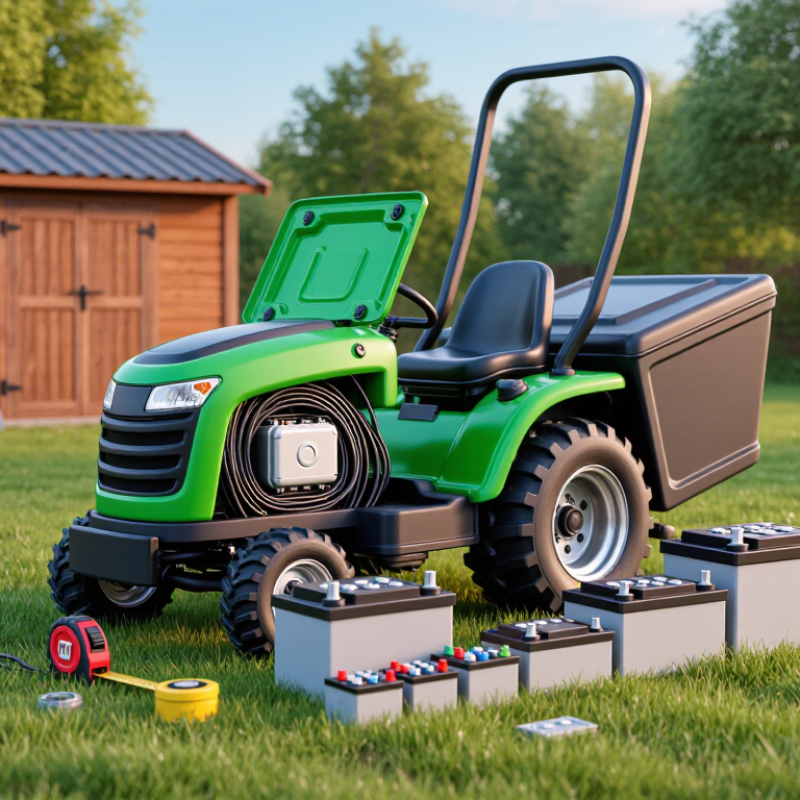
Before choosing a replacement, check the tractor’s manual and the label on its existing battery. Record the nominal voltage, battery type, and required capacity. Many lawn tractors use 12-volt batteries, but never assume yours does. Match the specified cold-cranking amps, or CCA, so the engine can start in cool weather. More is not automatically better. The charging system must suit the battery chemistry.
Size and fit matter just as much. Measure the case length, width, and height, including space beneath the hood. Check the terminal positions and polarity, then confirm that the cables can reach without bending or rubbing. A battery that looks close may still block a cover or strain a connection. Small details count. If the old label is faded, compare the manual with the dimensions and terminal layout before ordering. I have seen measurements taken at the case but not at the raised terminals; that can cause a frustrating mismatch.
For a supplier in China, request a specification sheet showing voltage, capacity, CCA, dimensions, terminal arrangement, and recommended charging limits. Ask how those figures are tested, and whether the battery is intended for starting rather than deep-cycle use. Confirm shipping weight and packaging too. A clear photo with a ruler beside the battery can help, but it cannot replace verified specifications. Verify every value against your tractor’s requirements before purchase.
| Specification or Requirement | What to Check | Typical Reference | How to Confirm a Match |
|---|---|---|---|
| System voltage | Check the voltage of the original battery and the tractor’s manual. | Many riding lawn tractors use a 12 V battery; some equipment uses a different electrical setup. | Match the specified voltage exactly. Do not choose based on physical size alone. |
| Battery group and dimensions | Record the battery group designation, length, width, and overall height, including terminals. | BCI Group U1 is common on many riding mowers. Dimensions vary by design and manufacturer. | Compare the replacement’s stated dimensions with the tray, hold-down, and available clearance. |
| Cold-cranking amps (CCA) | Check the minimum CCA specified for the engine and expected starting conditions. | Requirements vary by engine and climate; small-engine batteries commonly fall within a broad range of roughly 200–400 CCA. | Meet or exceed the equipment maker’s minimum. Compare CCA ratings measured under the same standard. |
| Terminal position and polarity | Identify positive and negative terminal locations while viewing the battery in the same orientation as the original. | U1 and U1R configurations can have different terminal layouts. | Confirm terminal positions, cable reach, terminal type, and clearance before ordering. |
| Battery chemistry | Check whether the tractor supports a flooded lead-acid or AGM battery. | Both types are used in lawn equipment. AGM batteries are sealed and generally do not require routine electrolyte checks; flooded batteries require appropriate maintenance. | Follow the tractor and charger instructions. Do not assume every charger or charging system is suitable for every chemistry. |
| Capacity and reserve | Compare amp-hour (Ah) capacity or reserve capacity when these values are specified. | Ratings depend on battery size and design; they are not interchangeable with CCA. | Use the original specification as a guide and confirm that the replacement fits the tray and charging system. |
| Charging requirements | Check the recommended charging voltage, charging procedure, and compatible charger type. | Requirements depend on battery chemistry and the tractor’s charging system. | Request the battery maker’s charging instructions and verify compatibility with the tractor or charger manual. |
| Operating temperature | Consider the lowest expected starting temperature and the conditions in which the tractor is stored. | Cold weather can reduce available starting power; heat can shorten lead-acid battery service life. | Choose a battery that meets the required CCA and follow storage and charging guidance for the expected climate. |
| Fit and secure mounting | Inspect the tray, hold-down, venting arrangement, and cable routing. | A correct voltage does not guarantee a safe physical fit. | Ensure the battery is firmly secured, terminals cannot contact metal parts, and cables are not stretched or pinched. |
| Supplier documentation | Request a current datasheet showing dimensions, voltage, CCA test standard, capacity, chemistry, terminal layout, and warranty terms. | Specifications and test methods can differ between products and suppliers. | Compare written specifications with the tractor manual and request confirmation of the exact model being supplied. |
| Final compatibility check | Use the tractor’s manual and the original battery label as the primary references. | Typical values are only screening guidance; requirements differ among tractors and engines. | Before purchase, verify voltage, minimum CCA, dimensions, polarity, terminal type, chemistry, and charging compatibility. |
Related Posts
-

Why Do We Need Different Types of Battery and Batteries?
-
Best Lawn Tractor Battery Options for Your Mowing Needs?
-

Top 10 Batteries Delivered for Global Buyers in 2026?
-

How to Choose the Right Lead Acid Battery Supplier?
-
What Is an SLA Battery and Which Type Is Best?
-

Top 12 Battery Types and Their Best Uses?