How to Choose the Best Rechargeable Sealed Lead Acid Battery?
Choosing the right rechargeable sealed lead acid battery can be challenging. Many options are available, each with unique features. This battery type is known for its reliability and performance. It powers various devices, from alarms to electric vehicles.
When selecting a rechargeable sealed lead acid battery, consider capacity and lifespan. Capacity affects how long your device will run. Lifespan is crucial for long-term use. An underperforming battery often leads to frustration.
Quality matters greatly in battery selection. Some brands claim high performance but fall short. Research consumer reviews and ratings. This helps you avoid unreliable products. A careful choice can save you time and money.
Understanding Sealed Lead Acid Batteries and Their Applications
Sealed lead acid (SLA) batteries are commonly used in various applications. They provide reliable power for devices such as security systems, emergency lighting, and mobility scooters. Understanding their features can help you make an informed choice.
One key aspect of SLA batteries is their maintenance-free design. Because of their sealed nature, they don’t require regular watering. This makes them convenient for users. However, their lifespan can be affected by temperature and charge cycles. It's essential to monitor these factors to ensure optimal performance.
Tips: Choose a battery with a higher capacity if you need longer run times. Look for options that can handle deep discharges. Don’t be fooled by low prices; quality matters. Inadequate batteries may lead to failures.
Understanding the applications of SLA batteries is crucial. They are widely used for backup power solutions in homes. They also play a significant role in industrial settings where reliability is a must. Yet, some may overlook the importance of correct sizing. A mismatch can lead to inefficiencies and reduced battery life. Always consider the required voltage and current before you buy.
How to Choose the Best Rechargeable Sealed Lead Acid Battery? - Understanding Sealed Lead Acid Batteries and Their Applications
| Parameter |
Description |
Typical Value |
| Voltage |
The electrical potential difference |
6V, 12V |
| Capacity (Ah) |
The total charge the battery can hold |
1.2Ah - 200Ah |
| Cycle Life |
Number of complete charge-discharge cycles |
200 - 1000 cycles |
| Weight |
The weight of the battery |
0.8kg - 60kg |
| Temperature Range |
Operating temperature conditions |
-20°C to 50°C |
| Applications |
Common uses for these batteries |
UPS, Alarm Systems, Medical Devices |
Evaluating Battery Capacity and Voltage Requirements for Your Needs
When choosing a rechargeable sealed lead acid battery, it's crucial to evaluate both battery capacity and voltage requirements. Battery capacity indicates how much energy the battery can store and is measured in amp-hours (Ah). For example, a typical 12V battery with a capacity of 7Ah can provide 7 amps for one hour. Understanding your power needs will help ensure you select a suitable capacity. Industry data shows that most applications require a minimum of 12% more capacity than initially estimated. This safety margin accounts for efficiency losses and unexpected power demands.
Voltage requirements are equally important. Many applications, such as emergency lighting and security systems, operate at 12V or 24V. It’s vital to match the battery voltage with your system's requirements to avoid potential damage. Misalignment in voltage can lead to reduced performance or even failure. A survey by the Battery Council International indicates that 45% of users experience performance issues due to improper voltage selections. This highlights the need for careful voltage assessment.
Evaluating both capacity and voltage will guide you in selecting a reliable battery. Be prepared to reassess your power needs as technology and usage demands evolve. This reflection can prevent underperformance and extend battery life. Always consider future needs alongside current requirements.
Assessing Cycle Life and Deep Discharge Capabilities
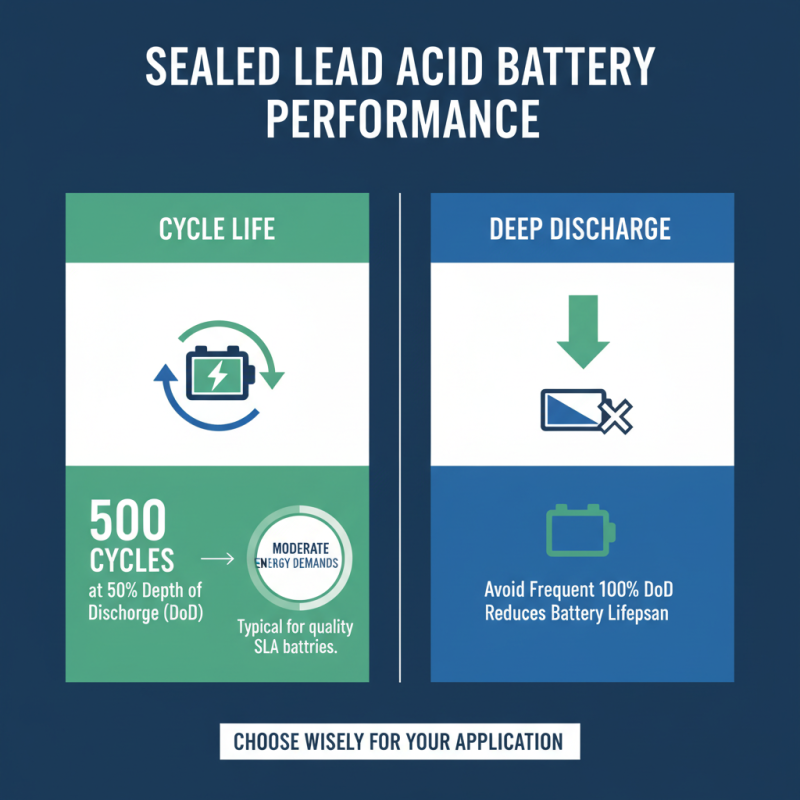
When choosing a rechargeable sealed lead acid battery, understanding cycle life and deep discharge capabilities is crucial. Cycle life refers to how many times a battery can be fully charged and discharged. Typically, quality sealed lead acid batteries offer around 500 cycles at 50% depth of discharge (DoD). This means they can be effectively used in applications where moderate energy demands are required.
Deep discharge capabilities are equally important. A battery that can handle deeper discharges tends to provide greater reliability in critical applications. Some batteries can manage up to 80% DoD, but this may shorten their lifespan. According to industry reports, routinely discharging below 50% can also lead to significant capacity loss over time.
Tip: Always check a battery's datasheet for specific cycle life details and DoD ratings. Assess the operational environment; extreme temperatures can impact performance. Instead of jumping to conclusions, consider how often you will discharge the battery. This will guide you to select a suitable option that balances life span with your energy needs. The choice may seem overwhelming, but reflecting on your usage patterns can simplify the process.
Comparing Brands and Cost for Optimal Battery Selection
When selecting a rechargeable sealed lead-acid battery, comparing brands and costs is essential. Recent market reports indicate that the price difference between various manufacturers can be substantial. For instance, prices can range from $30 to over $150 for batteries with similar specifications. This discrepancy often reflects the brand’s reputation, manufacturing quality, and research investments. A $50 battery may seem cost-effective but could underperform in longevity and efficiency compared to a $100 option, leading to higher long-term costs.
In terms of performance, industry data shows that high-quality batteries can often deliver up to 500 charge cycles. In contrast, lower-cost alternatives may only provide about 300 cycles. Choosing the right product requires careful consideration of your specific needs. This decision might involve trade-offs between upfront costs and long-term savings. Assuredly, consumers should reflect on their intended use. A battery used in critical applications might justify a higher investment.
Moreover, customer reviews are a valuable resource. They highlight performance issues that may not be visible at first glance. User experiences reveal that some cheaper batteries fail unexpectedly. This makes it imperative to look past initial savings and assess reliability and durability. A thorough evaluation of both brand reputation and cost can lead to more informed choices, ensuring optimal battery selection for your needs.
Checking Safety Features and Environmental Considerations
When selecting a rechargeable sealed lead acid battery, safety features should be top of mind. Look for batteries equipped with built-in fuses. These help prevent overcurrent situations. Battery management systems are also beneficial. They monitor temperature and voltage, ensuring safe operation.
Environmental considerations cannot be overlooked. Sealed lead acid batteries contain harmful materials. Choose models that are recyclable. This reduces environmental impact and aligns with sustainable practices.
Proper disposal is essential. Many communities offer recycling programs for hazardous waste. Always check local regulations for safe disposal.
In the quest for the best batteries, it’s easy to focus only on performance. However, safety and environmental impact deserve equal attention. Reflect on what makes a battery truly reliable. It’s not just about power; it’s about responsibility. Balancing performance with ecological considerations is vital for a conscientious choice.