7 Best 304 Stainless Steel Cups for Bulk Buyers
Bulk orders magnify small product differences. A cup that feels sturdy in one hand must still stack neatly, survive repeated washing, and arrive with consistent dimensions across hundreds of units. That is why choosing 304 Stainless Steel Cups takes more than comparing catalog photos and unit prices. Buyers should examine steel-grade documentation, wall thickness, rim finishing, capacity, surface quality, packaging, and sample consistency. A polished exterior can look convincing. It cannot verify the alloy.
For this guide, sourcing adviser Alex Morgan offers a practical buying principle: “Check the grade, the finish, and the paperwork before you compare the price.” Treat that as a checklist, not a substitute for supplier evidence. Request material documentation, inspect samples under ordinary lighting, and ask how production batches are checked. Feel the rim. Look inside for uneven seams or rough spots. Small details matter in daily use.
The seven options ahead are framed around real purchasing needs: dependable everyday service, attractive finishes, nesting efficiency, customization, and value at scale. Not every cup will suit every buyer. A café may favor fast stacking; a promotional distributor may prioritize consistent branding and lead time. Prices and specifications can also change, so confirm current details directly with the manufacturer. One honest limitation: a sample cannot guarantee every unit in a bulk shipment. Use clear specifications and written quality expectations to reduce surprises. A little extra checking now can prevent a very large box of the wrong cups.
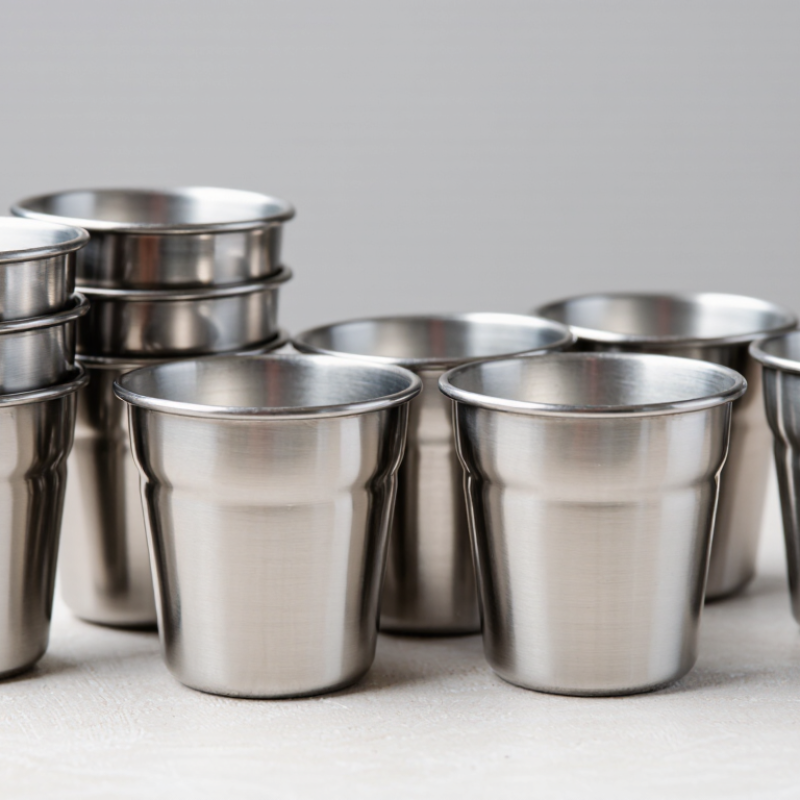
What 304 Stainless Steel Means for Bulk-Buying Cups
For bulk buyers, 304 stainless steel is a material grade, not a guarantee of perfect performance. It is commonly called 18/8 because it typically contains about 18% chromium and 8% nickel. Chromium helps form a protective surface layer, while nickel supports corrosion resistance and durability. The cup can handle everyday drinks, but it is not rustproof. Harsh cleaners, trapped moisture, or damaged finishes can still cause problems. Small details matter.
A grade label alone tells you little about construction. Ask whether the cup body, rim, and any exposed parts use 304 stainless steel. Request material documentation, then inspect a sample for sharp edges, uneven seams, and dents. Wall thickness also affects weight and feel; a very light cup may suit events, but it can feel less sturdy in daily use. Check care instructions, too. A polished surface may show scratches more readily than a brushed one.
Tips: Test samples with your actual cleaning routine before placing a large order. Compare capacity, stacking, and packaging, not just price. If a supplier’s specification is vague, ask for clarification. I would not assume every “stainless steel” component is 304 without written details.
7 Best 304 Stainless Steel Cups for Bulk Buyers
What 304 Stainless Steel Means for Bulk-Buying Cups
Type 304 stainless steel is specified to contain 18.0–20.0% chromium and 8.0–10.5% nickel by weight. These ranges are key parts of its material specification; confirm product-grade documentation when evaluating cups for bulk purchase.
Seven 304 Stainless Steel Cup Options for Bulk Buyers
For bulk buyers, the best 304 stainless steel cup depends on where and how it will be used. A café may value quick stacking, while an event team may need cups that withstand frequent handling. Small details matter. Check material documentation, capacity, rim finish, and sample quality before placing a large order. “304 stainless steel” alone does not describe every part or manufacturing detail.
Seven useful options cover common needs: a straight-wall cup is simple to clean; a rolled-rim cup feels smoother to drink from; a double-wall cup helps retain temperature; a stackable cup saves shelf space; a handled cup suits hot drinks; a lightweight cup is easier to carry; and a nesting cup works well for compact storage. Each design has trade-offs. Double walls can add weight, and tight stacking may make cups difficult to separate.
Compare actual samples, not just catalogue photos. Look for even seams, stable bases, and consistent dimensions across several pieces. Ask whether the stated capacity refers to the brim or a practical fill level. That difference can affect serving plans. It is also worth checking how cups look after repeated washing, since small scratches or water marks may show more clearly on polished surfaces. A modest trial order can reveal fit and handling issues before bulk quantities arrive.
7 Best 304 Stainless Steel Cups for Bulk Buyers – Seven 304 Stainless Steel Cup Options for Bulk Buyers
Representative product configurations for comparison. Dimensions and empty weights are indicative estimates, not specifications for a particular product; confirm materials, measurements, and tolerances with the supplier before ordering.
| Option | Capacity | Approx. Height | Approx. Rim Diameter | Approx. Empty Weight | Construction | Bulk-Buying Consideration |
| Compact single-wall cup | 240 ml / 8 oz | 8.5 cm | 7.2 cm | 70 g | Single-wall 304 stainless steel | Lightweight option for sampling, events, and compact storage. |
| Everyday single-wall cup | 355 ml / 12 oz | 10.5 cm | 8.0 cm | 95 g | Single-wall 304 stainless steel | A practical general-purpose size; check whether the rim is rolled for comfortable drinking. |
| Large single-wall cup | 473 ml / 16 oz | 12.5 cm | 8.5 cm | 115 g | Single-wall 304 stainless steel | Useful where capacity is a priority; single-wall metal can feel hot or cold to the touch. |
| Extra-large single-wall cup | 591 ml / 20 oz | 14.5 cm | 8.8 cm | 145 g | Single-wall 304 stainless steel | Compare packed dimensions and carton weight when planning storage and shipping. |
| High-capacity straight cup | 887 ml / 30 oz | 17.5 cm | 9.5 cm | 190 g | Single-wall 304 stainless steel | Confirm the base diameter and overall height fit the intended holders or storage racks. |
| Insulated compact cup | 355 ml / 12 oz | 12 cm | 8.2 cm | 180 g | Double-wall 304 stainless steel | Heavier than a single-wall cup; ask whether the design includes a lid and how it is packed. |
| Insulated everyday cup | 473 ml / 16 oz | 14 cm | 8.5 cm | 220 g | Double-wall 304 stainless steel | Consider insulation performance, lid fit, and added packaging when comparing landed cost. |
How to Compare Pricing, Customization, and Minimum Orders
For bulk buyers, a 304 stainless steel cup quote is useful only when specifications match. Compare capacity, steel thickness, cup weight, finish, lid, packaging, and freight—not just unit price. Ask whether the grade is documented and whether samples, tooling, or artwork setup are included. A low price may mean a thinner cup or plain carton.
Supply data offers context, not a guarantee. World Stainless Association reported 58.4 million tonnes of global stainless-steel melt-shop production in 2023, up 4.6% year over year. That figure does not confirm availability of a particular cup or finish. Get written lead times and quote validity. Compare prices at two quantities, such as 500 and 2,000 pieces; setup costs can distort unit-price comparisons. MOQ is not always negotiable.
Tips: Separate stock cups from custom runs. Request a sample and check its rim, finish, and weight before approving production. Ask for the MOQ on each logo method, since printing and engraving may have different setup costs. Small test first. Leave room for a little uncertainty: samples may not perfectly represent a full production batch.
What to Check Before Placing and Receiving a Bulk Order
Before approving a bulk order, request a signed specification covering 304 grade, wall thickness, capacity, dimensions, finish, and acceptable tolerances. “304” alone is not enough. Ask for a mill test certificate tied to the shipment, then verify a sample against the agreed drawing. Portable XRF testing can help identify alloy composition, but it does not reliably measure carbon. Use suitable lab testing if carbon content must be confirmed. Small detail. Big consequences.
Inspect samples for sharp rims, dents, uneven seams, rough interiors, and wobbling bases. Check usable capacity with water, not just the cup’s outer dimensions. For production lots, agree on a written inspection plan and defect definitions before goods leave the factory. The World Stainless Association reported 58.4 million tonnes of global stainless crude steel production in 2023. That figure describes industry output, not the quality of any individual cup or supplier. Keep the distinction clear.
When receiving cartons, compare labels and quantities with the purchase order, then inspect samples from several cartons—not only the top one. Photograph damage, retain packaging, and record measurements and test results. Confirm that cups nest without sticking and that protective packing prevents rim-to-rim scratches. Even a careful checklist can miss a recurring flaw; sampling reduces risk, but it cannot examine every cup. A practical plan should state how discrepancies will be handled before the shipment arrives.